
Customer support is entering its biggest transformation since the rise of the internet.
By 2030, AI is expected to automate up to 80% of routine customer service tasks, according to Gartner. Companies aren’t waiting to see what happens, they’re already using AI to slash response times, boost satisfaction scores, and save millions annually.
And here’s the twist: AI isn’t here to replace people. It’s here to help support organizations scale smarter, work faster, and deliver experiences customers actually remember.
If you want to see how AI is changing support today, and how to prepare your team for the next wave, just look at how companies like Delta, Sephora, Shopify, and American Express are using it right now.
Always-On Support That Actually Feels Human
Customers already expect 24/7 service, but for most companies, delivering that level of availability has been expensive and inconsistent. AI is rewriting the rules.
Modern AI-powered chatbots and virtual assistants can handle far more than basic FAQs. They’re able to understand intent, pull accurate information from multiple systems, and communicate in a way that feels natural.
Instead of waiting for a human agent, customers can resolve common issues, like tracking orders, resetting passwords, or troubleshooting software instantly. When the situation does require a human touch, AI collects all the context first, so the customer doesn’t need to repeat themselves. The result: faster resolutions, lower frustration, and a better overall experience.
For organizations, this unlocks true 24/7 coverage without the cost of staffing around the clock, while maintaining consistent service quality across every interaction.
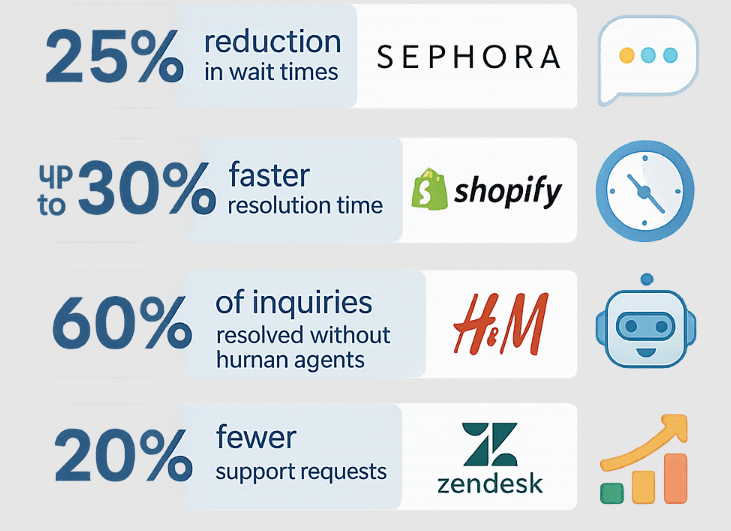
Take Sephora, for example. Their AI-driven chatbot on the website and app can not only answer product questions but also make personalized recommendations, check inventory, and book appointments at local stores, all without a human agent. When a conversation needs escalation, the bot hands it over with all the context, so the customer doesn’t repeat themselves.
This approach lets Sephora deliver consistent, human-feeling support any time of day while freeing up human staff for more complex or sales-focused conversations.
Giving Human Agents Superpowers
AI doesn’t just help customers it makes life easier for the people supporting them.
Intelligent tools can pull up the right information in real time, predict solutions based on past cases, and even draft personalized responses that agents can review and send. No more digging through outdated knowledge bases or juggling five different tools to find an answer.
This doesn’t just speed up interactions, it changes the role of the agent. Instead of focusing on repetitive, low-level tasks, agents can spend more time on problem-solving, empathy, and building stronger relationships with customers. In short, AI lets humans focus on the human parts of the job.
Shopify uses AI tools that automatically summarize support tickets, suggest solutions, and even draft full responses for agents to approve. This cuts average handle times while letting agents spend more time on situations that require empathy and critical thinking.
Similarly, KLM Royal Dutch Airlines uses AI to translate customer communications in real time, enabling support teams to handle over 14 languages without a massive, multilingual staff. AI doesn’t replace the agent—it makes them more capable and efficient.
Turning Support from Reactive to Proactive
Most support organizations still react to problems after customers reach out. AI has the potential to flip that model completely.
By analyzing product usage patterns, error logs, and behavioral data, AI can detect early warning signs that something is wrong like a spike in login failures or a sudden drop in engagement. Instead of waiting for tickets to flood in, the system can trigger proactive outreach: sending a solution, a status update, or even preventing the issue before it escalates.
For customers, it feels like magic. For organizations, it turns moments of potential frustration into opportunities to build trust and loyalty.
Delta Airlines uses predictive analytics to detect flight disruptions—like weather delays—and automatically reaches out to impacted passengers with rebooking options before they even ask. Customers aren’t left scrambling, and Delta avoids massive call center bottlenecks during peak disruption periods.
By catching problems early, AI helps turn potential frustration into loyalty-building moments.
Data-Driven Insights That Shape the Business
Every customer interaction generates data, but most of it sits unused. AI can change that by analyzing millions of conversations to uncover trends that human teams would miss.
It can highlight where customers are getting stuck, which products or features are driving the most questions, and where self-service options can reduce volume. These insights don’t just make the support team more effective, they inform product development, marketing strategies, and customer experience initiatives across the business.
With AI, support evolves from being a reactive cost center to a source of actionable intelligence that drives company-wide decisions.
Zendesk launched AI-powered analytics that lets businesses quickly identify friction points, such as a product feature driving spikes in tickets and track how self-service options reduce support volume. These insights don’t just improve customer support; they help product and marketing teams refine offerings, leading to fewer issues and happier customers overall.
AI turns support from a cost center into a source of intelligence that informs company-wide strategy.
Scaling Service Without Scaling Costs
Traditionally, growing a customer base meant hiring more agents. That model doesn’t hold up anymore.
AI allows support teams to handle growing demand without ballooning headcount. By automating repetitive tasks and boosting agent productivity, companies can keep service levels high without sacrificing profitability.
Startups can scale faster. Enterprises can reduce overhead. And both can use the savings to invest in better customer experiences and growth initiatives.
H&M deployed AI-powered virtual assistants across its digital channels, resolving most customer inquiries about orders, returns, and product availability without human involvement. This approach has allowed the retailer to maintain service speed and quality without dramatically expanding its global support headcount.
The result: lower operational costs and happier customers, as they get near-instant answers to their questions.
The Human Role Will Evolve, Not Disappear
There’s a lot of fear about AI replacing human agents entirely. In reality, the shift will be more about evolution than elimination.
As AI takes over repetitive tasks, human agents will transition into roles that demand deeper expertise and emotional intelligence. They’ll handle complex escalations, act as relationship managers, and become trusted advisors for customers.
Support leaders will need to rethink how they hire and train. Future agents will need stronger problem-solving abilities, product knowledge, and soft skills rather than just speed and efficiency.

American Express uses AI to handle routine fraud checks and transaction disputes but still relies on highly trained human agents for complex financial cases where nuance and trust matter most. Those human agents act more as problem solvers and relationship builders rather than script followers.
Support teams of the future will need people with stronger product expertise, problem-solving abilities, and emotional intelligence—skills that make AI a complement, not a competitor.
Why Acting Now Is Critical
AI in customer service isn’t a future trend, it’s already here. Businesses across industries are deploying AI-driven chatbots, analytics tools, and workflow automation. The organizations that move first will build stronger systems, train their teams on new technologies, and collect the data needed to keep improving.
Those that wait will struggle to retrofit AI into outdated processes and risk falling behind competitors who deliver faster, smarter, more personalized support.
The message is clear: start small if you need to, but start now. Test AI tools in your workflows, experiment with automations, and prepare your teams to work alongside the technology.
The Bottom Line
AI isn’t replacing support organizations, it’s transforming them. It automates what’s repetitive, augments human abilities, and allows teams to deliver better, faster, and more personalized support at scale.
The companies that embrace this shift today will set the standard for customer experience tomorrow. Those that don’t will be left scrambling to catch up.
The future of customer support isn’t just about AI, it’s about how well we use it to serve customers better.
 Azure Advice