
What Happens When AI Meets the Azure SRE AGENT? It Writes the Fix.
Meet the Azure SRE Agent — an intelligent, autonomous system purpose-built to raise the bar on application reliability.
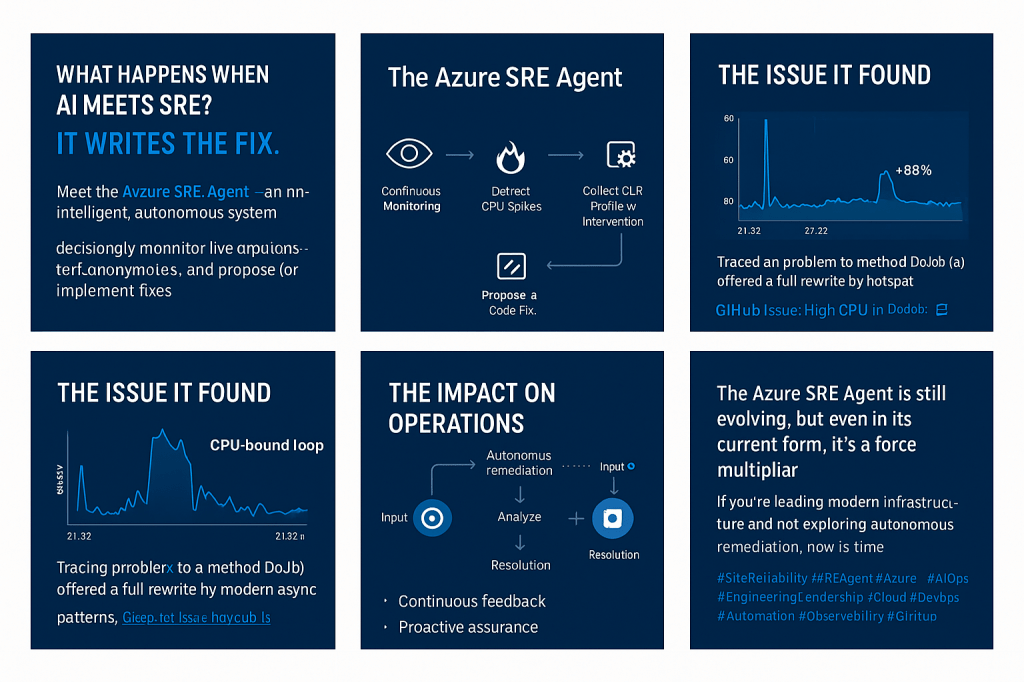
It continuously monitors your applications in real time, detects abnormal behavior, diagnoses root causes at the code level, and proposes (or implements) precise, production-safe fixes — all without human intervention.
Think of it as a tireless Site Reliability Engineer who’s fluent in telemetry, infrastructure, and source code. It doesn’t just surface alerts. It understands your system — end to end — and takes proactive steps to resolve issues before they escalate.
What sets the SRE Agent apart is this:
It sees like an observability platform
Thinks like an engineer
Acts like a developer
Delivers like an automation pipeline
It operates across your full stack — code, runtime, infrastructure — turning raw signals into high-confidence diagnostics, and diagnostics into GitHub issues, PRs, and if you allow it, automated fixes.
This is SRE AGENT is not just monitoring, not just alerting — but closing the loop with intelligence and autonomy.
I recently ran a test using the Azure SRE Agent — no custom configuration, just the default setup — and it quietly delivered something profound:
Without human intervention, it:
- Detected a high CPU spike in a production web app
- Captured a deep CLR profile
- Pinpointed the exact line of code causing the issue
- Proposed a safe, optimized code change
- Created a GitHub issue with a detailed remediation plan
- Offered to open a feature branch and submit a pull request
This wasn’t just observability. It was closed-loop remediation, driven by intelligent automation.
The Problem
The agent discovered that DoJob() contained an unbounded loop:
while (enabled)
{
    for (int j = 0; j < 1000; j++) ;
    Thread.Yield();
}
This tight loop spun the CPU at ~88% usage, tying up request threads and locking the app in high-load mode until Disable() was manually triggered.
The Fix It Proposed
It recommended:
- Replacing the CPU spin with an async, cooperative loop using
Task.Delay() - Capping work by time (to avoid locking up the thread)
- Respecting
CancellationTokenfor graceful exits - Optional: moving the long-running logic into a
BackgroundService
It even prepared a minimal, safe code patch.
📌 GitHub Issue: High CPU in DoJob()
Example 2: Memory Bloat in a Scheduled Job
Scenario: A background job responsible for nightly data aggregation was leaking memory, gradually pushing memory consumption to over 1.2 GB and triggering restarts.
What the SRE Agent Did:
- Detected a steady memory climb during off-peak hours
- Captured a memory dump and ran a snapshot analysis
- Identified a LINQ operation that was creating millions of short-lived string objects due to an inefficient projection
- Suggested a fix to reuse string buffers and batch processing
Impact:
- Memory usage dropped by 67% post-patch
- No downtime or customer impact
- Improved system resilience and job completion time
Example 3: Latency Spike from Third-Party Dependency
Scenario: A spike in request latency was observed, but only on certain routes during specific times of day.
What the SRE Agent Did:
- Correlated the spike to increased response times from a third-party payment API
- Traced the call path to a synchronous HTTP call blocking threads
- Suggested migrating the logic to an async pipeline and implementing circuit breaker logic with Polly
Impact:
- Latency reduced by 40%
- Retry logic added to prevent cascading failure
- Business team avoided missed transactions during peak hours
Why This Matters
We’re seeing a shift from passive observability to autonomous resilience.
Instead of just alerting, the agent understands the system — and takes steps to fix it.
This saves engineers time, avoids production incidents, and lays the foundation for self-healing systems.
For Engineering Leaders, This Means:
✔️ Shorter MTTR
Incidents are detected, diagnosed, and proposed for resolution faster than human teams can respond.
✔️ Happier Teams
No late-night pages. Developers stay focused on building, not debugging.
✔️ Scalable Reliability
The agent doesn’t tire. It brings consistent, intelligent monitoring and remediation across services.
The Azure SRE Agent is still evolving — but even in its current form, it’s a force multiplier for any engineering team.
It doesn’t just help you find problems faster. It shortens incident lifecycles, lightens the load on your engineers, and elevates your operational maturity overnight. And it does all of this autonomously — at scale, and in real time.
If you’re leading modern infrastructure and still relying solely on dashboards, alerts, and manual triage, you’re operating a step behind.
Autonomous remediation isn’t a futuristic concept. It’s here — and it’s working.
Now is the time to explore what’s possible when intelligence moves from observability into action.
#SiteReliability #SREAgent #Azure #AIops #EngineeringLeadership #Cloud #DevOps #Automation #Observability #GitHub
 Azure Advice