Why Humor Might Be the Most Underrated Accelerator of AI Adoption
Picture this: It’s 11pm. A developer is staring at a memory dump the size of a small novel, fueled by cold coffee and sheer spite. They ask their AI diagnostic tool what’s wrong.
It responds:
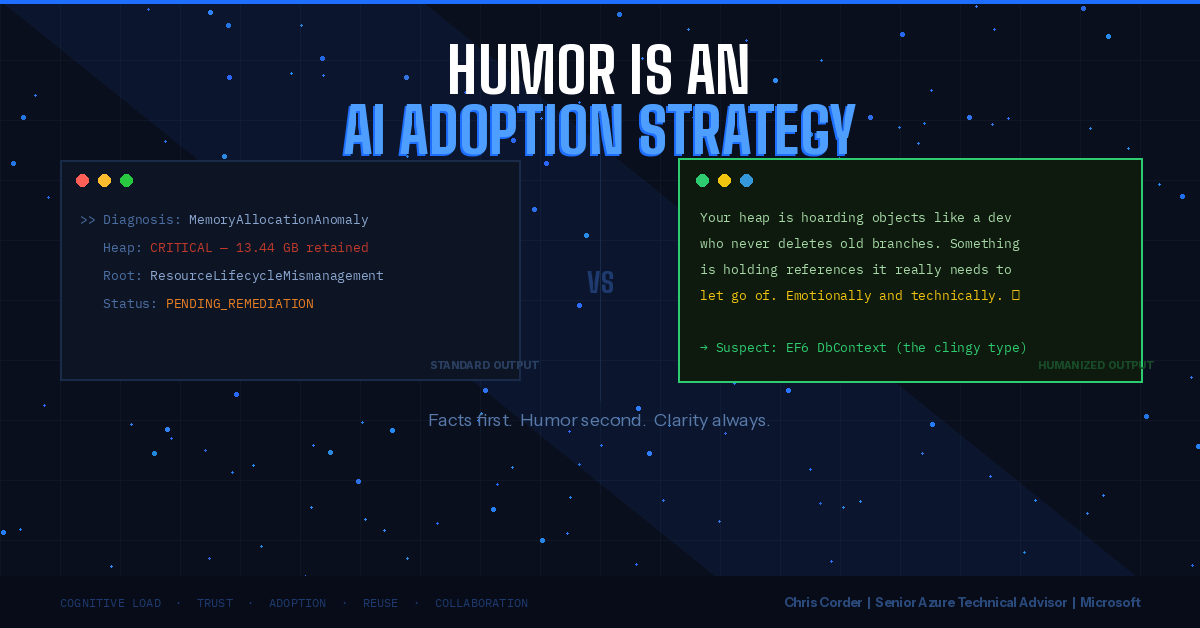
“Multiple memory allocation anomalies have been detected across several managed heap segments, suggesting potential object retention issues consistent with resource lifecycle mismanagement.”
Accurate. Thorough. And about as energizing as reading the terms and conditions on a rental car agreement.
Now imagine instead it says:
“Your heap is hoarding objects like a developer who never deletes old branches. Something is holding references it really needs to let go of. Emotionally and technically.”
Same diagnosis. Same precision. Completely different experience.
One makes you feel like you’re drowning in documentation. The other makes you snort, nod, and actually keep reading.
That moment, that tiny shift in how information lands, is what this article is about. And it matters more than you might think.
We obsess over AI adoption metrics: usage rates, time-to-value, ROI. But we rarely ask the question that actually predicts all of them: do people enjoy using this thing? Not just tolerate it. Not just acknowledge it works. Actually look forward to opening it.
Humor, used well, is one of the most direct levers we have for answering that question with a yes. It reduces cognitive load, builds trust, and transforms a tool from something people have to use into something they want to use. That’s not a soft, feel-good claim. It’s a design principle with real adoption consequences.
We talk a lot about AI in terms of performance, accuracy, scalability, and ROI.
All valid. All important.
But there’s a quieter factor that determines whether people actually use AI tools day-to-day, or just nod approvingly in demos and go back to their spreadsheets:
How it feels to interact with them.
The Problem with “Perfect” AI
Most AI systems today are technically impressive and emotionally inert.
They produce correct answers, structured outputs, and clean summaries, formatted like a compliance document written by a very efficient, very joyless robot.
For engineers and analysts grinding through production incidents, network traces, and RCA reports, that creates a specific kind of exhaustion. Not technical friction. Cognitive friction.
And cognitive friction is insidious. It doesn’t announce itself. It just quietly makes people less likely to reach for the tool next time. Then the time after that. Until the tool that cost six figures to build is being politely ignored in favor of a Slack message to a colleague who actually explains things in plain English.
The fix isn’t a better model. Sometimes it’s just a better sentence.
Humor Is a Cognitive Release Valve
Consider two outputs delivering the same signal:
Standard: “High retransmission rate detected indicating packet loss.”
Humanized: “Packets are being dropped like it’s a Friday afternoon deploy.”
Or take thread pool saturation:
Standard: “Available worker threads have been exhausted. Requests are queuing beyond acceptable thresholds.”
Humanized: “Your thread pool looks like Frodo at Mount Doom. Technically still moving. Barely. Do not add more load.”
Same data. Very different experience.
Humor makes dense information easier to process. It improves readability in long analysis outputs. It keeps the brain engaged rather than glazed. In high-signal environments where attention is already stretched thin, that’s not a small thing.
This isn’t just intuition. It’s grounded in how the brain processes information under stress. A moment of levity interrupts the fatigue loop, resets attention, and makes the content that follows easier to retain. You’re not just making the tool more pleasant. You’re making it more effective.
And that effectiveness translates directly into the thing everyone actually cares about: adoption.
Humor Builds Trust, and Trust Drives Adoption
Here’s something we don’t say enough:
People don’t evaluate AI purely on correctness. They evaluate it on relatability.
When a tool explains something in a way that feels human, not performatively human but genuinely conversational, it reduces the “black box” feeling. It signals understanding. It shifts the dynamic from machine producing output to collaborator helping you think.
In technical domains where skepticism is not only healthy but professionally required, that trust is everything. A tool that feels approachable gets questioned less and used more. Its outputs get shared with teammates. Its recommendations get acted on instead of second-guessed.
And crucially, trusted tools get championed. The engineers who love a tool become its internal advocates. They demo it in team meetings, mention it in incident retrospectives, and bring it up when leadership asks what’s working. That kind of grassroots adoption is worth more than any top-down mandate.
Humor, when it lands right, is one of the fastest paths to that trust.
And Trust Drives Reuse
The best tools aren’t just accurate. They’re used repeatedly.
A tool that feels heavy, rigid, or mentally draining gets quietly avoided, even when it’s powerful. People will find a workaround before they’ll keep fighting a tool that exhausts them.
A tool that’s clear, approachable, and occasionally even enjoyable? People come back. They recommend it. Adoption follows organically.
️ The Balance: Precision First, Personality Second
To be clear: humor should never come at the cost of accuracy. And it’s worth being honest about the risks.
Humor that misreads the room can undermine credibility faster than any technical error. A joke during a Sev 1 customer outage doesn’t land the same way it does in a routine analysis summary. Humor tied to sensitive topics, specific people, or organizational dynamics can alienate exactly the users you’re trying to win over. And over-reliance on personality can actually erode trust if users start to wonder whether the wit is papering over shallow reasoning.
The guardrails matter:
In high-stakes environments, the evidence layer stays precise, diagnostics stay defensible, and root cause analysis stays clean. Non-negotiable. Humor should never appear where ambiguity could be costly, where a reader might wonder if the lightness means the tool isn’t taking the problem seriously.
But layered on top of rigorous output? A measured amount of personality transforms the experience without compromising the integrity.
The model I keep coming back to:
Facts first. Humor second. Clarity always.
One Practical Framework, With Real Examples
In the tools I’ve been building, including AI-powered diagnostic agents for Azure App Service support engineering, we break outputs into layers:
- Evidence Layer -> Strictly factual. No humor. Full stop. Raw telemetry, stack traces, and metrics are presented with precision. This is the foundation that makes everything else trustworthy.
- Analysis Layer -> Clear, structured explanations. Patterns are named, causes are reasoned through, and the logic is visible. Still no jokes here. This layer earns credibility.
- Summary Layer -> Light humor and analogies where appropriate. This is where the Friday deploy line lives. Where Frodo shows up. Where the heap gets called out for its hoarding behavior.
This approach mirrors what the best technical communicators already do naturally. Think of it like the difference between a doctor who gives you a precise diagnosis in clinical terms and then says “basically, your knee is throwing a tantrum and needs a week off.” The precision came first. The analogy just made it stick.
Tools that follow this pattern consistently outperform their personality-free counterparts in one specific metric: voluntary reuse. Engineers don’t just use them when required. They reach for them first.
The Bigger Idea
We’re not just building AI tools. We’re building AI collaborators.
And the best collaborators explain things clearly, reduce stress during complex work, and make hard problems feel manageable.
Sometimes, a single well-placed line does exactly that.
AI adoption isn’t purely a technical challenge. It’s a human one. And if we want people to genuinely embrace these tools, not just greenlight them in a budget meeting, we need to design experiences that feel understandable, trustworthy, and yes, occasionally enjoyable.
Because sometimes the difference between a tool that gets used and one that gets shelved is as small as a sentence that makes someone smile at 2am during a Sev 2.
And if you’ve made it this far in the article without checking your monitoring dashboards, congratulations. Your on-call rotation would like a word.
Curious whether others are seeing this dynamic on their teams: are the AI tools people actually love using any different in “feel” from the ones that get ignored?
 Azure Advice