There is a quiet problem building at the foundation of modern AI, and it does not get nearly enough attention outside of research circles. It has two parts, and understanding both of them matters whether you are building AI systems, using them, or just trying to figure out how much to trust their output.
Part One: The Internet Was Never a Clean Dataset
Every major language model trained today was fed, in large part, on the internet. That sounds reasonable until you stop and think about what the internet actually is.
It is not a balanced, curated, peer-reviewed corpus of human knowledge. It is the largest repository of bias, misinformation, SEO spam, propaganda, and confident wrongness that has ever existed. It is dominated by English and Western perspectives. Underrepresented communities, minority languages, and non-dominant viewpoints exist in the data, but statistically, they get drowned out. Older content vastly outnumbers newer content by sheer volume, which means models can absorb outdated facts as quietly as they absorb current ones.
The filters applied during training help. They are not sufficient. You cannot filter your way to a neutral dataset when the source material is structurally skewed.
The result is models that speak with tremendous fluency about things they are subtly, systematically wrong about. Not randomly wrong, which would be easier to catch. Skewed in predictable directions that reflect the shape of the data they were trained on.
Garbage in. Garbage out. But delivered in a voice that sounds authoritative.
Part Two: AI Is Now Polluting Its Own Water Supply
This is the part that keeps researchers up at night, and it should get more mainstream attention than it does.
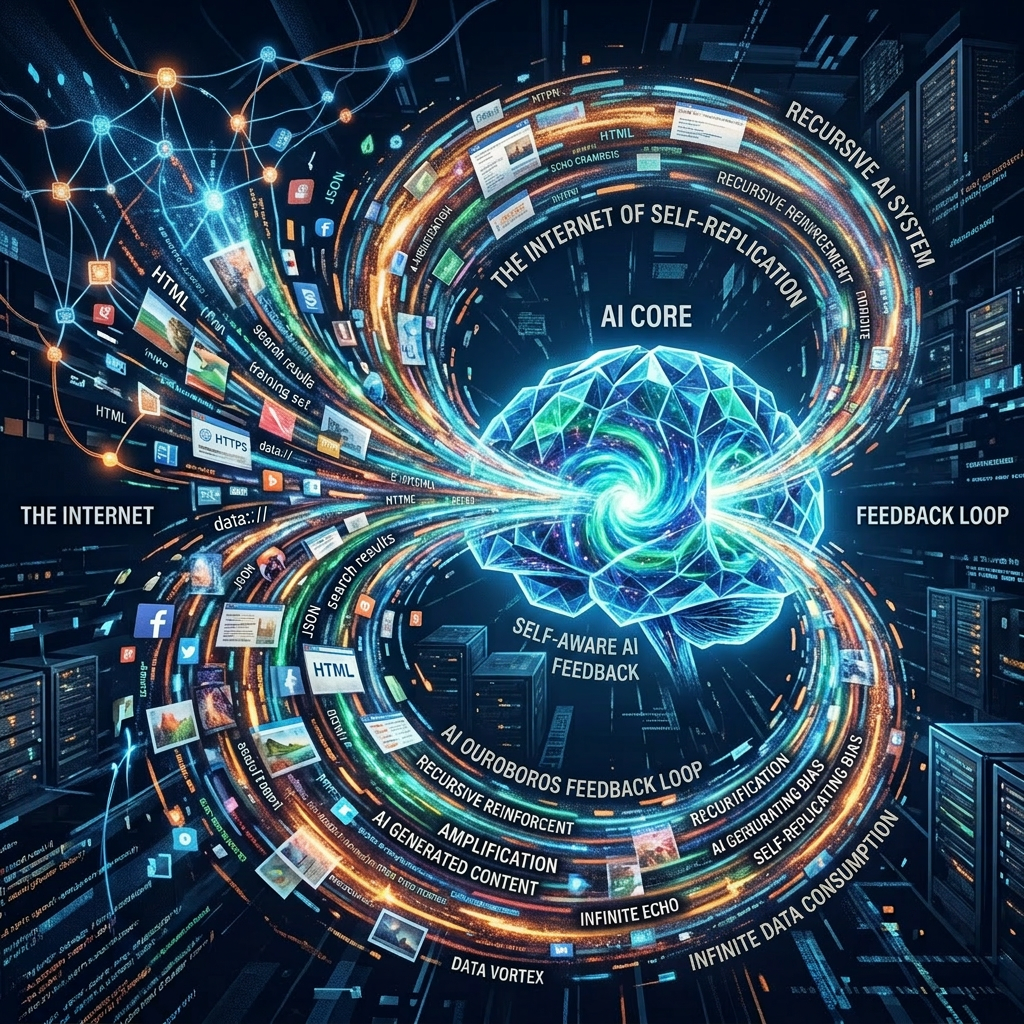
As AI-generated content floods the internet, the next generation of models trains on it. The distortions compound.
Here is the mechanism:
A model trained on human data produces outputs that are slightly off. It smooths over rare cases. It amplifies common patterns. It introduces subtle hallucinations that sound plausible because they fit the shape of what it has seen. That output gets published on the web. Articles, forum posts, Q&A threads, social media content. The next model trains on it, inheriting the distortions and adding new ones. Repeat.
Researchers call this model collapse. The technical effect is that the model’s output distribution narrows over generations. The long tail of rare but real human knowledge, the unusual facts, the minority perspectives, the niche expertise, gets progressively washed out. What remains is fluent, confident, statistically average.
Think of it like making a photocopy of a photocopy of a photocopy. Each generation degrades the signal. The degradation is hard to detect because the output still looks and sounds clean. The model does not know what it has lost.
Why This Is Particularly Dangerous
Hallucinations become canonical. If a model generates a plausible-sounding fact that gets indexed and scraped, a later model may treat it as ground truth. There is no mechanism to automatically flag the origin.
Epistemic monoculture. Models may converge toward a narrow band of acceptable reasoning patterns, suppressing intellectual diversity in ways that are invisible until you go looking for it.
No obvious detection method. Unlike a bad human source you can critique and attribute, a contaminated training set is invisible. The model has no way to distinguish learned knowledge from inherited error.
The feedback loop is already active. Some estimates suggest a significant fraction of new web content is already AI-generated. We are not describing a theoretical future risk. The cycle has started.
What Is Being Done About It
Researchers are working on data provenance tracking, synthetic data detection, and maintaining curated human-only datasets as a gold standard for training. These are all meaningful efforts.
They are also partial solutions to a structural problem. The field does not have a clean fix. It is an active area of concern in AI safety research, which is a polite way of saying smart people are working hard on something that does not yet have a satisfying answer.
What This Means Practically
If you are building systems on top of AI-generated output, think carefully about where that output eventually goes. If it re-enters any data pipeline, any training corpus, any indexed content system, you are contributing to the loop whether you intend to or not.
If you are using AI to accelerate your work, that is entirely reasonable. Just treat the output the same way you would treat a very fast, very confident junior colleague who occasionally makes things up and does not always know when they are doing it. Useful. Not unsupervised.
And if you are evaluating AI systems for high-stakes decisions, ask the vendors directly: what is your provenance strategy? How are you detecting and managing model collapse risk across training iterations? The quality of their answer tells you a lot.
The internet was always a polluted water source. AI is now both drinking from it and adding to the pollution simultaneously. The least we can do is understand the dynamic clearly and build accordingly.
Christopher Corder is a Senior Azure Technical Advisor at Microsoft, specializing in App Service performance engineering, diagnostics, and AI-powered tooling. Views are his own.

